How to Build a Feedback Loop Into Your AI Workflow in Four Steps
Author:
Alex Crease

This is Part 2 of a series on AI in LCA and EPD practice. In Part 1, we walked through how CarbonGraph applies AI across the full workflow. Here we go deeper on the single idea underneath all of it, the feedback loop.
Every AI tool for life cycle assessment gets one thing done fast and then stops learning. It matches a bill of materials, fills a data gap, drafts a report, and the next project starts from the same place as the last one. That is automation, and automation plateaus. The tools that compound are the ones built around a feedback loop, where every correction makes the next result better. In sustainability work, where you are never right on the first try, that loop is not a nice-to-have. It is the whole point. This post explains why, then shows you how to build the loop into your own workflow, in whatever AI tool you use.
Why One-and-Done Automation Hits a Ceiling
The current wave of AI-for-LCA tools automates discrete tasks. That is genuinely useful, and it is also inherently limited. A tool that generates an EPD draft in one click produces the same quality of draft on your hundredth project as your first, because nothing about your corrections flows back into it. The verifier feedback you worked hard to resolve last quarter teaches the tool nothing. You carry the lesson in your own head and apply it by hand, every time, forever.
This is the difference between a tool that does work and a tool that learns from work. Automation without a feedback loop is a photocopier, fast, consistent, and permanently stuck at its current level. That ceiling is invisible when you are comparing demos, because a one-time output looks impressive. It becomes obvious around the tenth project, when you are still fixing the same categories of mistakes by hand.
Automation makes a task faster once. A feedback loop makes every future version of the task better.
Why Sustainability Work Demands Feedback Loops
LCA and EPD work is iterative by nature, more than almost any other technical deliverable. You build a model, write a report, submit for third-party verification, receive feedback, revise the model, revise the report, and resubmit. The loop is not a failure mode. It is the actual shape of the work, mandated by the verification process itself.
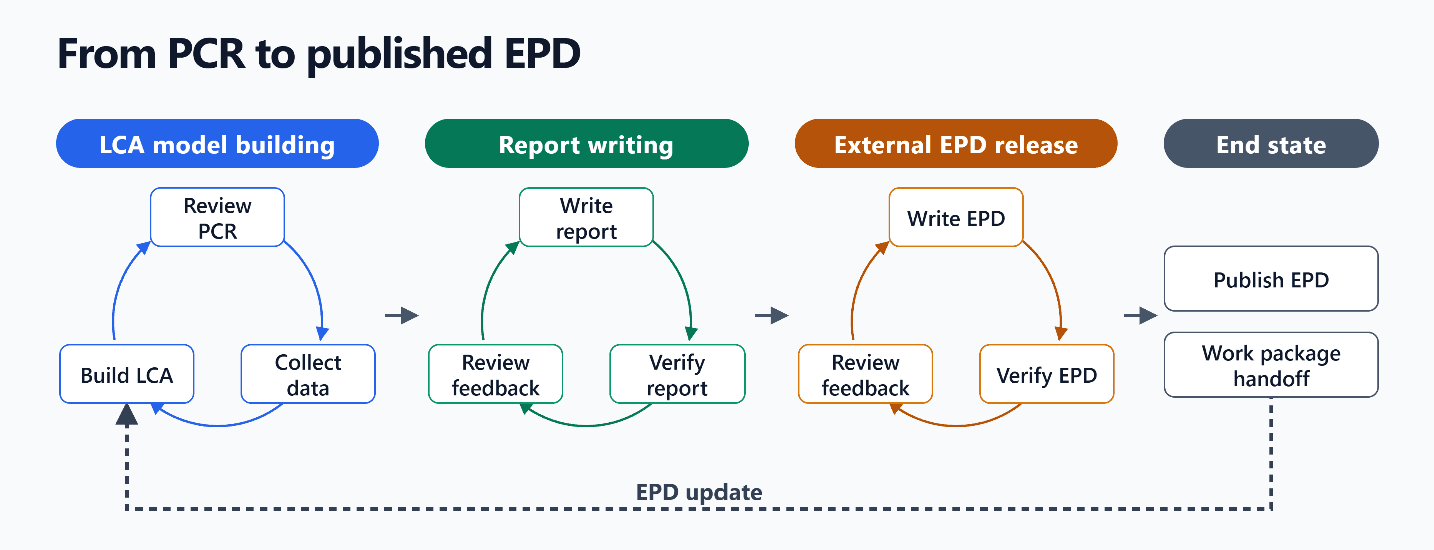
That makes sustainability an unusually good fit for feedback loop-based AI, and an unusually bad fit for one-and-done automation. If the work is inherently iterative and your tool cannot iterate, the tool is fighting the grain of the process. Worse, the most valuable knowledge in the whole workflow, what a verifier flagged and how you resolved it, is exactly what a one-and-done tool throws away after every project.
There is a deeper version of this loop as well. Being a sustainable organization is itself a continuous-improvement problem. No company is sustainable on its first try. It gets there by measuring, finding the biggest levers, acting, and measuring again. The loop that improves an LCA is the same shape as the loop that improves a product, which is the same shape as the loop that improves a business. Once you see it, you can start building it everywhere.
The Four Steps, and How to Run Them Yourself
The mechanism is concrete, and you do not need a specific platform to start. This can be applied to any task, with any AI agent.
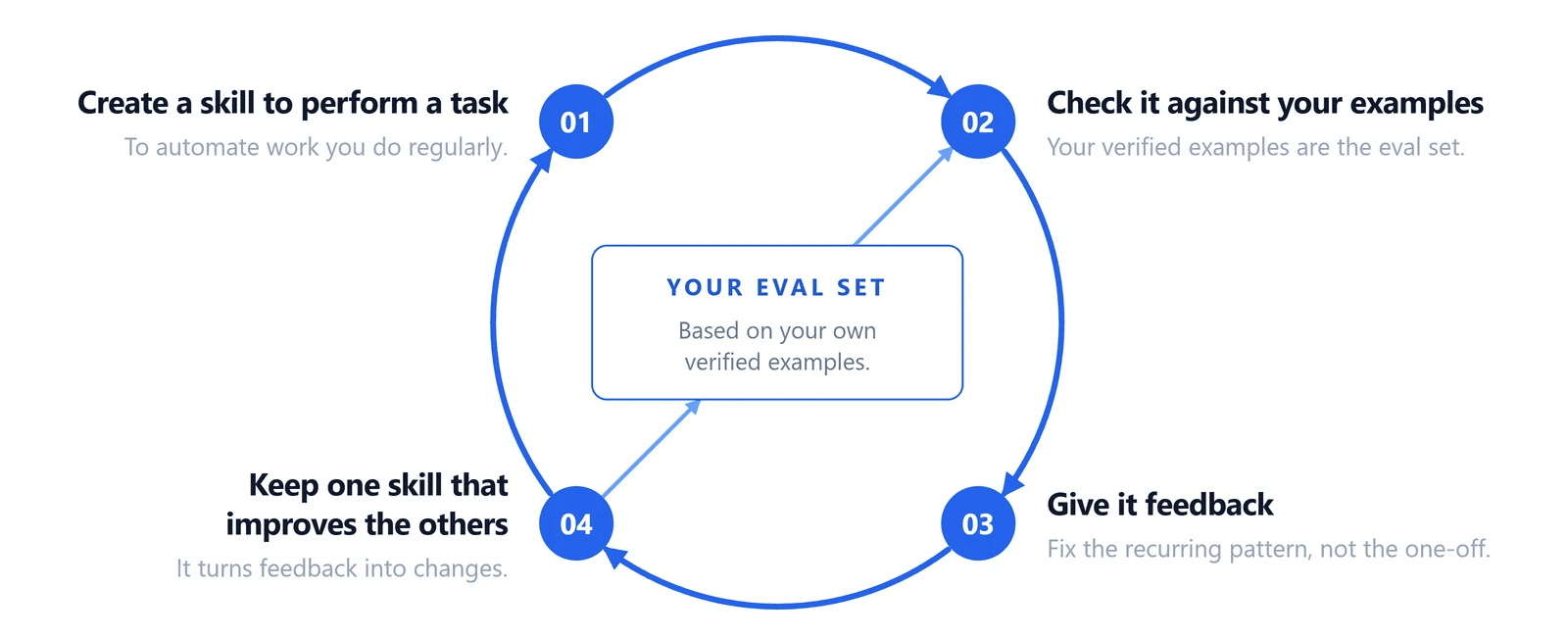
1. Create a skill to do the task. Something that drafts the report from your model export and your project context. Build it, give it your context, and let it draft one of your own reports. The first output will not be good. That is the point of step two.
2. Check it against your own verified examples. Your past verified reports are the ground truth, and a handful is enough. They are your eval set, the hurdle every future change has to clear. A second skill can do the checking, grading each draft against what you already know good looks like.
3. Give it feedback, and fix the recurring pattern, not the one-off. A single stray comment is noise. The correction you keep making, project after project, is the signal. Fix that at the source rather than by hand each time.
4. Keep one skill whose only job is to improve the others. It takes the feedback, from a verifier, a reviewer, or you, finds the recurring patterns, turns them into rules, tests those rules against your eval set, and updates the skills that draft and check. This is the step almost nobody builds, and it is the one that makes the other three compound.
The eval set is not static either. That fourth skill adds a new check every time feedback surfaces something new, so the definition of good keeps rising. Ours has grown to dozens of checks and counting, and every one of them came from something a reviewer or a verifier actually caught on a real project.
The skill that matters most is not the one that writes the report. It is the one that improves all the others every time you get feedback.
Run this across enough projects and the compounding is real. The tools stop repeating the mistakes they made before, because the corrections are structural now rather than carried in your memory. Keep yourself in the loop on purpose, though. The goal is not an autonomous system, it is one that does the grind and hands you the judgment calls. Anything that becomes an external claim gets your sign-off, every time.
Do this and the tool you use matters far less than the discipline you bring to it. That is the real advantage, and no vendor can hand it to you fully formed.
Two Free Skills to Start With
We gave two talks at ACLCA 2026 that put this into practice with real projects.
AI in LCA Practice, Lessons from the Field was the practitioner's playbook for building this exact loop into your own work, whatever tool you use, and where we went deepest on continuous improvement.
From PCR to EPD, AI Workflow Lessons in Practice showed the loop applied end to end on one real EPD, from Product Category Rule selection through published, third-party verified disclosure.
To help you start, we are sharing two free skills, a report writer and the improver that makes it better from your feedback. They are a seedling, not a finished tool. Feed them your past reports, give them feedback, and they grow into something tuned to how you work. Download them here.
How CarbonGraph Is Built Around Feedback Loops
CarbonGraph is a next-generation LCA platform that helps organizations move from product data to verified environmental disclosures in a single, structured workflow. The loop is not something we added to it. It is how the platform is built, and it is how we work.
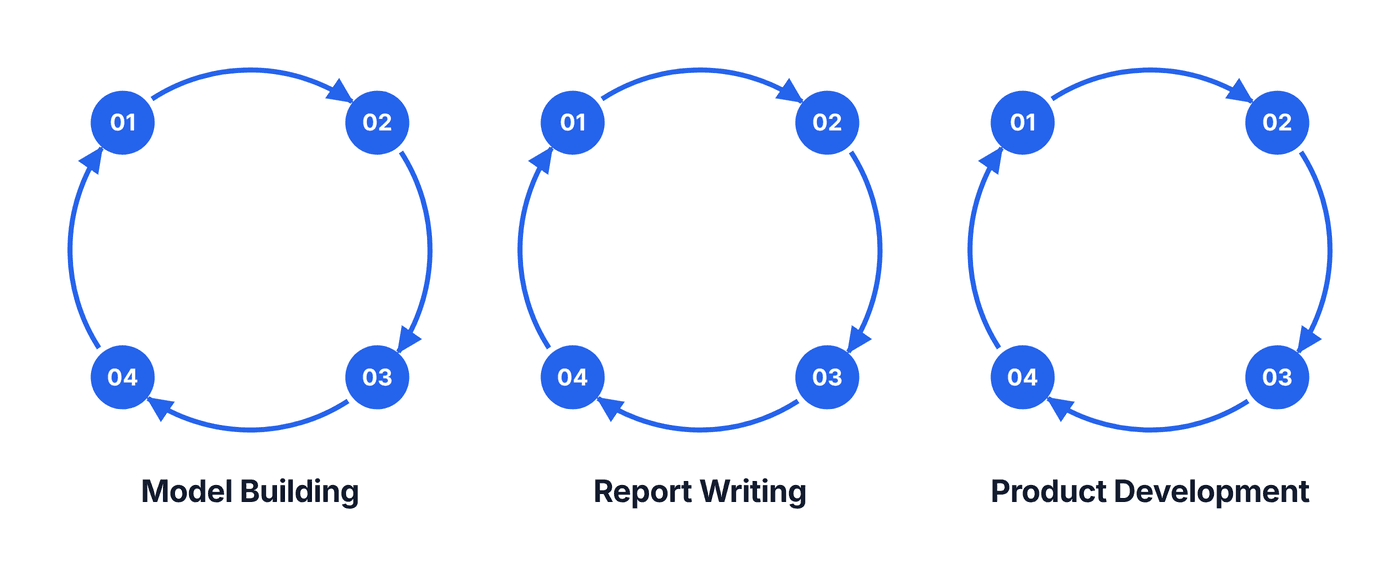
In our own consulting practice, the skills that draft and check an assessment run against an eval set built from reports we have taken all the way through verification. When a verifier flags something, the correction does not stop at that project. It becomes a rule, the rule is tested against the eval set, and the next assessment is better at exactly the thing the last one got wrong. That is why the eval set keeps growing, and why it is the most valuable artifact we own.
We use the same feedback loop to develop new product features. Every piece of customer feedback tells us something about where CarbonGraph could be improved, and those become experimental product changes rather than notes in a document nobody reopens. With agents to develop and test features, and customer feedback coming in weekly, our AI tools learn how to write, test, and ship code better every cycle.
Ready to prove your sustainability advantage with a workflow that gets better every project? Get in touch.
Read Part 1, How CarbonGraph Uses AI Across the LCA and EPD Workflow, for the full picture of where AI fits across Life Cycle Assessments.