How CarbonGraph Uses AI Across the LCA and EPD Workflow
Author:
Alex Crease

Most AI tools for life cycle assessment promise the same thing: automate the model, generate the EPD, and do it all in one click. That is the easy part to sell and the wrong part to solve. The model has rarely been where LCA and EPD projects get stuck. The time and the rework live everywhere around it, turning messy supplier data into something calculable, interpreting a hundred-page Product Category Rule, drafting a defensible report, and surviving verification. This post walks through how CarbonGraph applies AI across that full workflow, why everything works from one shared context, and why the real advantage is not a smarter one-shot tool but a shared context hub that learns from every round of feedback.
Why "AI for LCA" Usually Means the Wrong Thing
Search for AI-powered LCA software and the pitches blur together, automated bill-of-materials matching, data-gap filling, one-click EPD generation. These are real capabilities and they save real time. But they optimize the same narrow slice, building the model, and treat everything else as an afterthought.
Anyone who has taken a product LCA through to a verified Environmental Product Declaration knows the model is rarely the bottleneck. A first EPD can take months, and only a small fraction of that is modeling. The rest goes to collecting and cleaning data, reconciling it against the PCR, documenting assumptions, writing the report, and reworking all of it after a verifier responds. Automating the model faster does not touch most of that.
The model is the easy part. The hard part is everything around it, the data going in, and the defensible outputs coming out.
CarbonGraph is built around that reality. AI earns its place at the edges of the assessment, where the iteration actually happens, not just where the calculations happen.
AI LCA Tools With One Shared Context
CarbonGraph has two AI tools, and they sit at the two ends of the assessment rather than in the middle.
EcoScan builds the model: Give it a prompt, describe your product, or upload what you already have. It builds the life cycle assessment model from there, constructing a life cycle inventory where one is needed or working from yours where you have it, matching your inventory data to ecoinvent datasets, and running the model. What it removes is not the calculation. It is the hours spent turning a bill of materials and a folder of supplier documents into something calculable in the first place.
The CarbonGraph AI Agent sits next to your model: It holds the whole model in context, the architecture as well as the numbers, so you can ask it things rather than go digging. Summarize the hotspots. Audit the model against the PCR. Run a scenario. Find the mistake you are fairly sure is in there somewhere. It answers in plain language, which matters most when the person who needs the answer is not the person who built the model.
Both work from the same project, and that shared context is what makes them more than two separate features. More on that below.
How CarbonGraph Applies AI Across the Workflow
We think about AI assistance across the full path from product data to a verified disclosure. Here is where EcoScan and the CarbonGraph Assistant do the most good.
Turning Messy Inputs Into Usable Data
The first real cost in any assessment is structuring what the client actually has, spec sheets, bills of materials, spreadsheets, supplier PDFs, and half-remembered details from email threads. AI is well suited to this because the failure mode is safe. A good assistant flags a gap or proposes a proxy from real data and asks you to confirm, rather than guessing silently. It turns pages of documentation into a structured starting point you can check, far faster than building that structure by hand.
Interpreting the PCR Into Model Rules
A Product Category Rule can run to a hundred pages, with requirements scattered throughout. Translating that text into concrete modeling constraints, the declared unit, the system boundary, which modules are required, is slow, high-stakes work. An assistant that holds the PCR and the model in the same shared context surfaces the relevant rules as they apply, and cites the clause it is applying, so the constraints are encoded as the model is built rather than reconstructed later under verification pressure.
Drafting the Report and Documentation
Report writing is one of the largest and least discussed time sinks in the EPD process, and one of the areas the rest of the market has barely touched. CarbonGraph generates documentation from the model as it is built, so assumptions are captured in the moment instead of reconstructed from memory weeks later. The draft still needs a practitioner's judgment, but starting from a structured, model-grounded draft is a different task than starting from a blank page.
Supporting Better Decisions, Not Just Faster Reports
A verified number is not the goal. The reason to run an LCA is to make a better decision, which material to change, where the biggest reduction opportunity sits, whether a design change is worth it. An assistant that understands the model can surface the few levers that actually matter and quantify a scenario, so the assessment becomes a recommendation a business can act on rather than a report that gets filed away.
The Real Advantage: a Feedback Loop, Not a Better Tool
Here is where CarbonGraph parts ways with the one-click crowd. An LCA is never right on the first try. You build a model, write a report, submit for verification, get feedback, and revise. That loop is the actual shape of the work, and most AI tools ignore it, because a one-and-done automation has nothing to learn from.
We build the loop in deliberately, and in practice it runs as a small set of skills that work together. A report writer drafts from the model and project context. A reviewer grades that draft against an eval set, a stored set of known-good examples that defines what good looks like. And an improver takes the feedback, from a verifier, a reviewer, or you, finds the recurring patterns, and updates the writer and the reviewer so the next report is better at exactly what the last one got wrong. The eval set grows as the improver adds checks. Ours has grown to dozens of checks and counting.
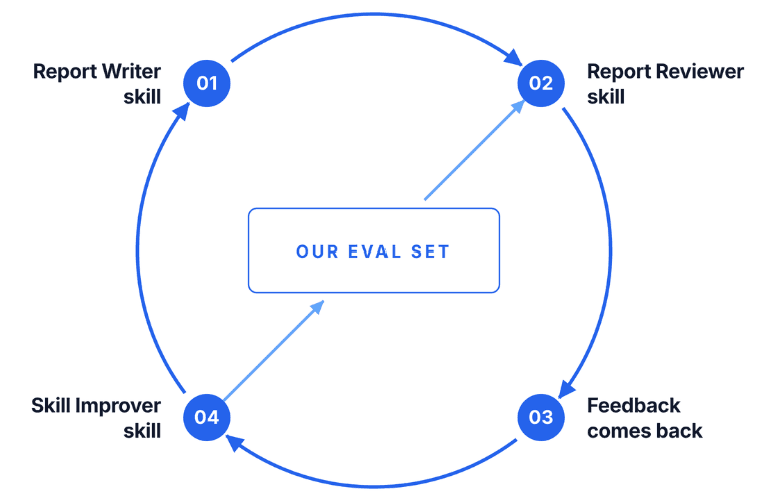
The advantage does not come from a better tool. It comes from closing the loop, so every project makes the next one faster and more defensible.
This is why we treat AI assistance as a practice, not a product feature. The same loop that improves a single LCA improves the tools that build it, and, one level up, the way an organization improves its products over time. Continuous improvement is not a slogan here. It is the mechanism.
One Shared Context, So the Whole Team Works From the Same Place
The other half of the advantage is where all of this lives. In a typical EPD project, the PCR sits in one place, the product data in another, the model in a tool disconnected from the report, and the verifier only ever sees the finished document. Every handoff is a chance to lose context and a reason for rework.
A CarbonGraph project holds all of it in one place: the governing PCR, the product and supplier data behind the model, the model itself, the documentation generated as it was built, and the assumptions and decisions recorded along the way. Open the project and you are looking at the assessment, not at one artifact extracted from it. That is what shared context means here, and it is why the AI tools are useful at all. EcoScan and the CarbonGraph AI Agents are not reading a file someone handed them. They are working inside the same project you are, with access to the same shared context.
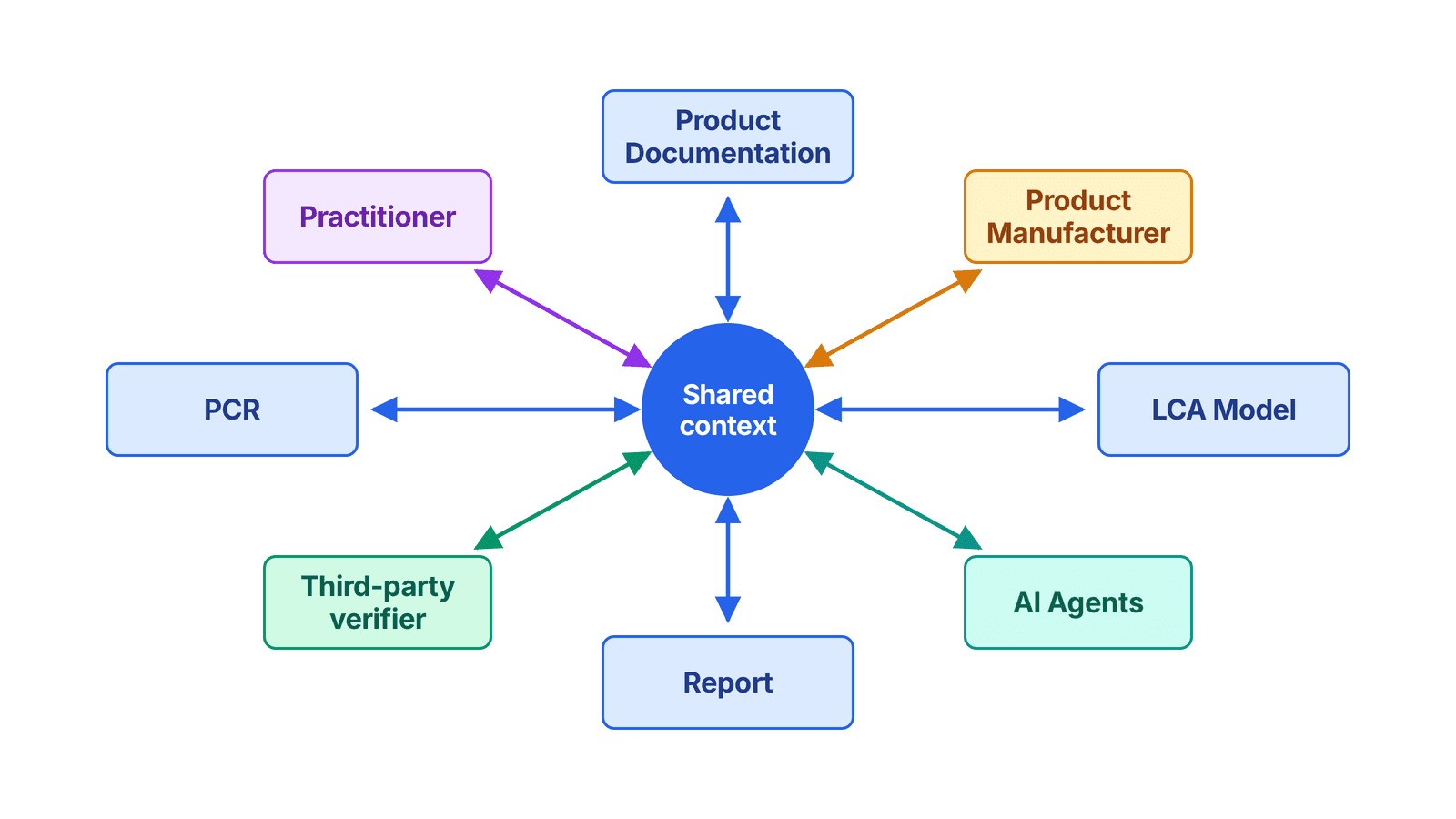
That shared context extends to the people as well as the tools. Verifiers can use the same assistant you do to interrogate the model directly, so their feedback lands exactly where it needs to change rather than arriving as comments on a PDF. That is what turns a months-long verification cycle into weeks, and frees the time saved for the work that matters, helping the business decide what to do next.
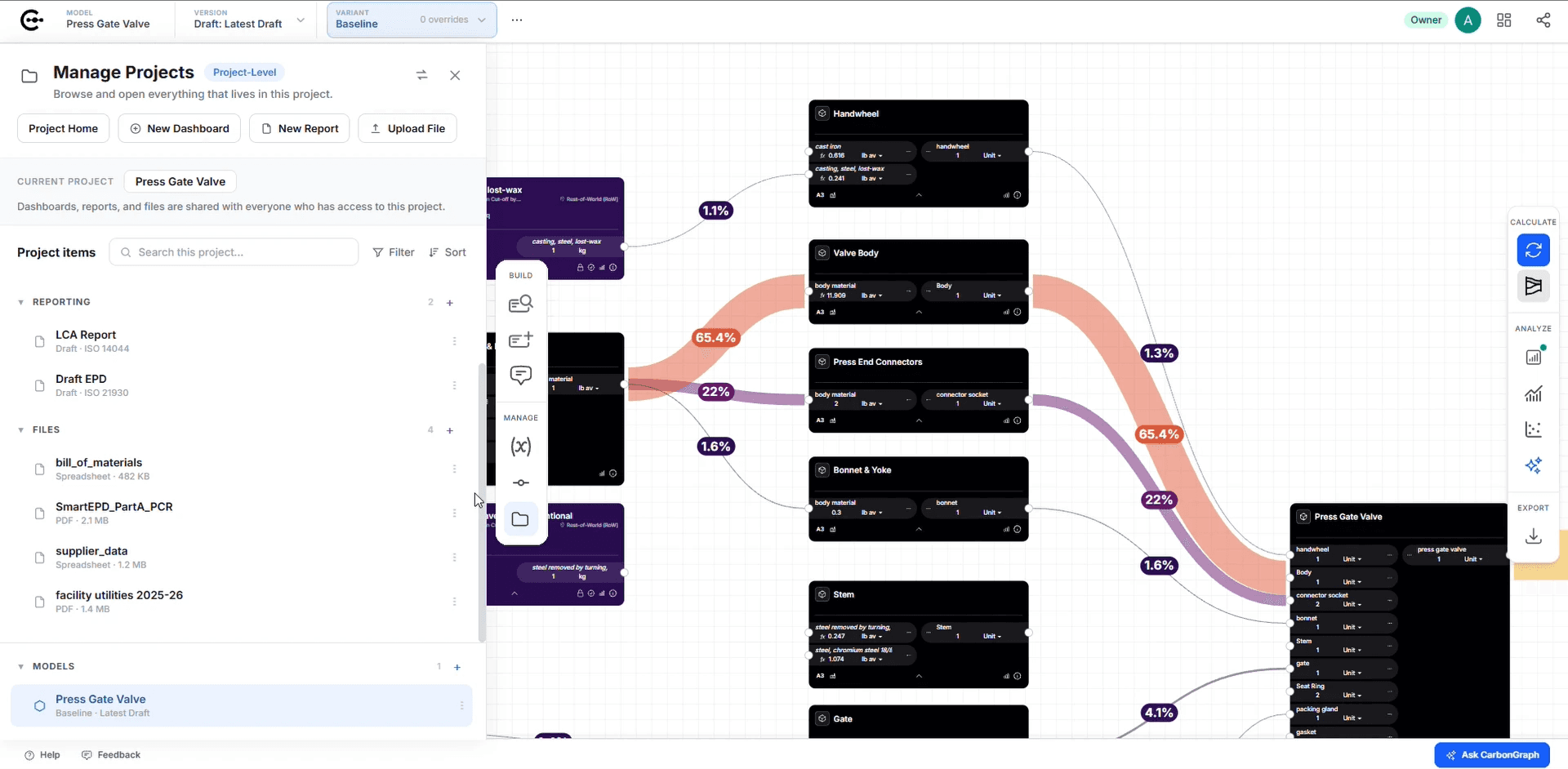
AI agents in CarbonGraph can reference the PCR, BOM, and other supplier documentation for model auditing and editing.
Two Free Skills to Start With
We gave two talks at ACLCA 2026, both built on lessons from real projects rather than theory.
AI in LCA Practice: Lessons from the Field was the practitioner's playbook for working with AI, how to make any AI tool improve over time by closing the feedback loop, whatever platform you use.
From PCR to EPD: AI Workflow Lessons in Practice walked one real project from Product Category Rule selection through to a published, third-party verified Type III EPD, and showed where AI assistance prevented the rework that usually stretches these timelines.
We also shared two free AI skills you can run in whatever tool you already use, a report writer and the improver that makes it better from your feedback. They are a starting point, not a finished tool, and you grow them with your own reports. You can download them here.
A Better Way to Prove Your Sustainability Advantage
CarbonGraph is a next-generation LCA platform that helps organizations move from product data to verified environmental disclosures in a single, structured workflow. We structure product and manufacturing data in one place, build defensible models aligned with PCRs, generate documentation as the model is built, and let verifiers work in the same shared context, so teams reach a first EPD faster and pass verification with fewer iterations.
Ready to prove your sustainability advantage? We will build your first model with you. Get in touch.
Continue to Part 2: How to Build a Feedback Loop into Your AI Workflow in Four Steps