OUTCOMES

Environmental
product
declarations

CarbonGraph helps manufacturers prepare PCR-aligned EPDs from their own product data. Build one model and get EPDs for your entire product family.

OUTCOMES

Environmental
product
declarations

CarbonGraph helps manufacturers build PCR-aligned EPD models from their own product data, cover a whole product family, and share the model directly with their verifier.

What is an EPD?

What is an EPD?

An Environmental Product Declaration (EPD) is a third-party-verified quantification of a productโ€™s environmental impacts. It helps buyers understand your product's footprint and compare it fairly.

An Environmental Product Declaration (EPD) is a third-party-verified quantification of a productโ€™s environmental impacts. It helps buyers understand your product's footprint and compare it fairly.

Comparable data

Gives buyers and specifiers product data they can evaluate within your product category.

Comparable data

Gives buyers and specifiers product data they can evaluate within your product category.

Verified proof

Standardized documentation and review builds buyer trust.

Verified proof

Standardized documentation and review builds buyer trust.

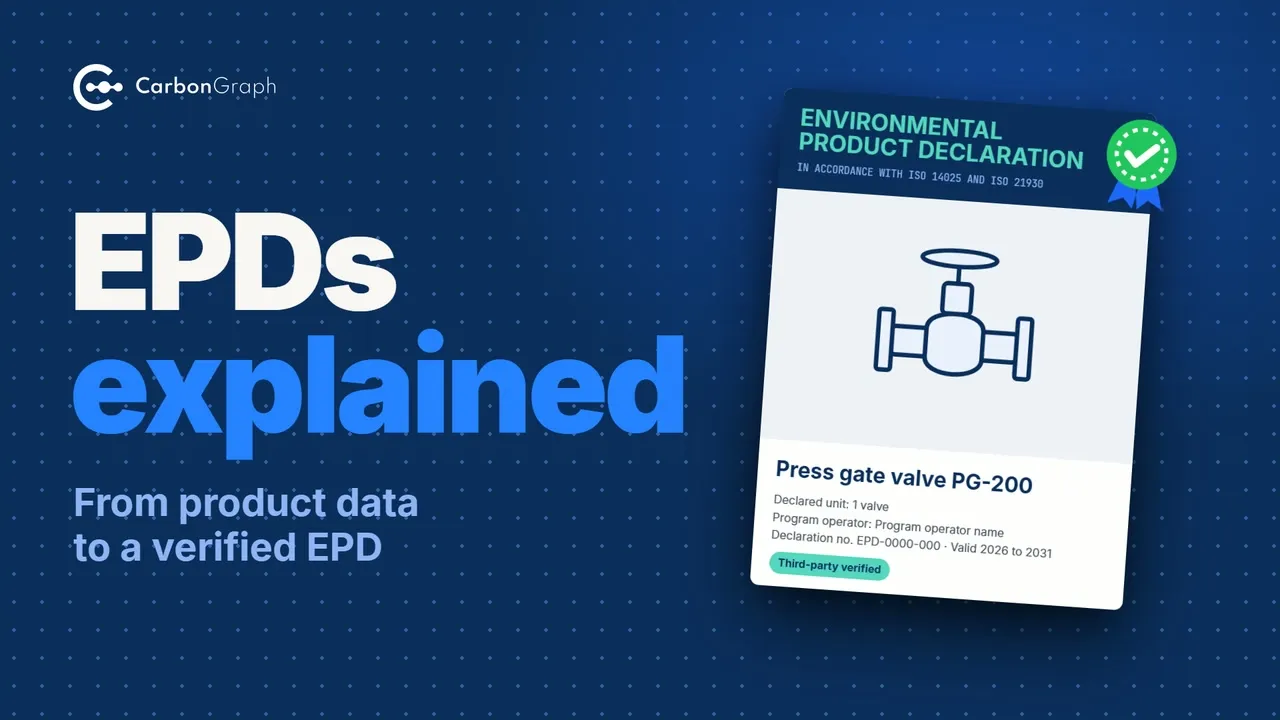
An EPD (Environmental Product Declaration) made from CarbonGraph

Common uses

EPDs are used when customers need clear, verified environmental information to evaluate products. They help manufacturers meet buyer expectations and compete in sustainability-driven decisions.

Support procurement decisions and bid evaluation

Enable access to sustainability-driven markets

Meet requirements in project specifications

Compare products within defined product categories

Typical challenges

Typical challenges

Producing an EPD requires aligning detailed product data with strict rules and third-party review expectations. Without a structured process, this can become slow, costly, and difficult to manage.

Producing an EPD requires aligning detailed product data with strict rules and third-party review expectations. Without a structured process, this can become slow, costly, and difficult to manage.

High upfront cost

Traditional EPD projects carry high service fees, and each new product often means a new study.

High upfront cost

Traditional EPD projects carry high service fees, and each new product often means a new study.

PCR alignment

Modelers must ensure Product Category Rules (PCRs) are applied consistently.

PCR alignment

Modelers must ensure Product Category Rules (PCRs) are applied consistently.

How CarbonGraph streamlines EPDs

CarbonGraph structures the EPD as one workflow, from product data to a verification-ready model, and keeps that model ready for your next product or update.

Modeled how it's made

Modeled how it's made

Your model follows your real materials and process steps, so every result is easy to trace and review.

Your model follows your real materials and process steps, so every result is easy to trace and review.

One model, many SKUs

One model, many SKUs

Your whole product family is covered under one consistent method and verified all at once. Adding a SKU is an update, not a new study.

Your whole product family is covered under one consistent method and verified all at once. Adding a SKU is an update, not a new study.

Built from shared context

Built from shared context

All of the documentation lives alongside the model, and you and your verifier both have access to it.

All of the documentation lives alongside the model, and you and your verifier both have access to it.

What you need to know about EPDs

Learn what an EPD is, who is asking for them, and how to get one.
Ready to prove your sustainability advantage?

We'll build your first model with you.

Ready to prove your sustainability advantage?

We'll build your first model with you.

Ready to prove your sustainability advantage?

We'll build your first model with you.