For data center suppliers
Verified EPDs
for your whole
product line
Meet data center EPD requirements across your whole catalog, and turn lower impacts into a competitive edge.
Third-party verified · ISO 21930 and EN 15804 compliant
Built for suppliers of…
Noise abatement
Valves and flow control
Piping
Cable and cable management
Conduit
Cooling and MEP distribution
And more
Why now
Win the spec with an EPD
Hyperscalers increasingly require EPDs from suppliers as they work to reduce embodied carbon. The iMasons Climate Accord and Open Compute Project define the proof data center builders need to scope their projects.
That proof is an EPD.
What an EPD does for you
Win bids
Meet EPD requirements in project specs
Compare impacts
Show product-specific, comparable results
Outcompete
Win when your impact beats competitors
Get listed
Show up when buyers search supplier databases for products
Product families
Every SKU, one model
You sell product families of many sizes and configurations. We build one life cycle assessment (LCA) model that calculates results for the entire family.
01
Every SKU gets its own results and EPD.
02
Change a shared process and every result updates.
03
Add or update SKUs without starting over.
Illustrative example · one model set up for each size
Fully managed
From product data to published EPD
We manage every step so your team can stay focused on making and selling products.
Data collection
We tell you what data we need and help you gather it.
Model building
One LCA model, built to your PCR, calculates results for every SKU.
Verification
An independent verifier approves the model under your NDA.
Publication
Your EPD gets published and listed in supplier databases like EC3.
Win with proof
We build sales assets that make your EPD a selling point.
How it works
Going from zero to EPD
Learn how the EPD process works and how CarbonGraph accelerates each step, from zero to EPD.

Further reading
From the CarbonGraph blog


FAQ
What is an EPD?
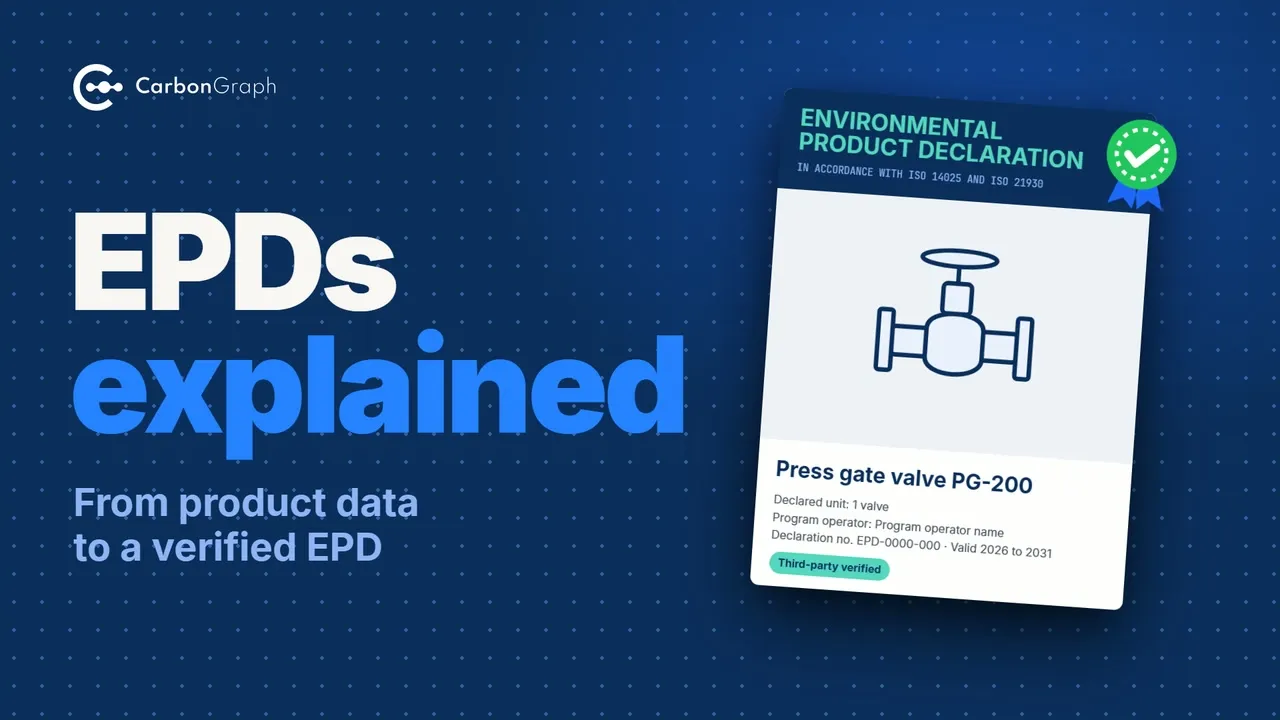
An Environmental Product Declaration (EPD) is an independently verified report of a product’s environmental impact across its life cycle. It follows the Product Category Rules (PCR) for that product type and is published through a program operator.
What’s the difference between an EPD and a life cycle assessment?
A life cycle assessment (LCA) is the private study that calculates a product’s environmental impacts across its life cycle. An EPD is the standardized, independently verified summary of those results that you publish and share, following the Product Category Rules (PCR) for your product type. Every EPD is built on an LCA, which is why the LCA has to follow the PCR from the start.
What is a PCR?
Product Category Rules (PCR) set how EPDs are made for a specific product type: what to include, how to calculate the results and how to report them. They’re what make EPDs for similar products comparable. We confirm the right PCR before modeling starts, and the verifier checks your LCA and EPD against it.
Why are data center buyers asking for EPDs?
Hyperscalers increasingly require EPDs from suppliers as they work to reduce embodied carbon, and EPDs give them verified, product-level data to do it. Many data center projects now ask suppliers for EPDs as part of the bid.
What can I do with an EPD once it’s published?
Include it in bids that require one, share it with buyers and contractors, and point them to its public listing with the program operator. A product-specific EPD shows your actual results rather than an industry average.
Which products can CarbonGraph model?
CarbonGraph is built to model any manufactured product. We’ve built models for noise abatement walls, valves, cooling products and more, and that’s just the start.
Do I need a separate study for every size?
No. We build one model of the product family that can be set up for every size and configuration, so each product gets its own results. Whether sizes are published as one EPD or several depends on the PCR and the program operator.
How does third-party verification work?
We share the model and report with a certified verifier through our partner program. They review it for accuracy under your NDA and approve the final EPD for publication. The verifier reviews the baseline model once inside the shared model, and only variant inputs need checking.
What’s the difference between an EPD and a product carbon footprint?
A product carbon footprint (PCF) reports a product’s climate impact, but it isn’t designed for comparing products. An EPD follows the PCR for your product type, is independently verified, and is what data center bids ask for.
How do I get started?
Book a walkthrough and tell us which product family you need an EPD for. We’ll show you how we’d take it from data collection to a published EPD.
Next step
Get started on your EPD journey
Tell us which product family you need an EPD for. We’ll show you how we’d take it from data collection to a published EPD, so you can compete for data center project bids.