What is an Environmental Product Declaration?
Author:
Alex Crease
Thinking about an EPD? Here's What You Need to Know
So you’re thinking about getting an Environmental Product Declaration (EPD). An EPD is one of the most credible ways to communicate your product’s environmental performance, but the process can involve unfamiliar terminology, standards, and requirements.
This is the first in a three-part series that breaks down how EPDs work, what is required to produce one, and how organizations can successfully move from product data to a verified environmental product declaration.
What is an Environmental Product Declaration (EPD)?
An Environmental Product Declaration (EPD) is a third-party verified, public-facing disclosure of a product’s environmental impact. It provides standardized information about how a product performs across its lifecycle, from raw materials to manufacturing, and in some cases, use and end-of-life. EPDs are widely used by procurement teams evaluating suppliers, engineers and architects specifying materials, and sustainability teams tracking environmental performance.
To publish an EPD, a company evaluates impacts across the product lifecycle using Life Cycle Assessment (LCA) according to internationally recognized standards. The results are reviewed by an independent verifier and published in a standardized format.
Indicators reported in an EPD include:
GHG emissions
Ozone depletion potential
acidification potential
eutrophication potential
resource and energy use
waste generation
Because EPDs follow standardized rules and undergo third-party verification, they provide one of the most credible and transparent ways to communicate environmental performance.
The EPD Process at a Glance
Producing an Environmental Product Declaration requires a structured workflow that moves from product data to a verified environmental disclosure. Take a look at this diagram to understand the EPD process:
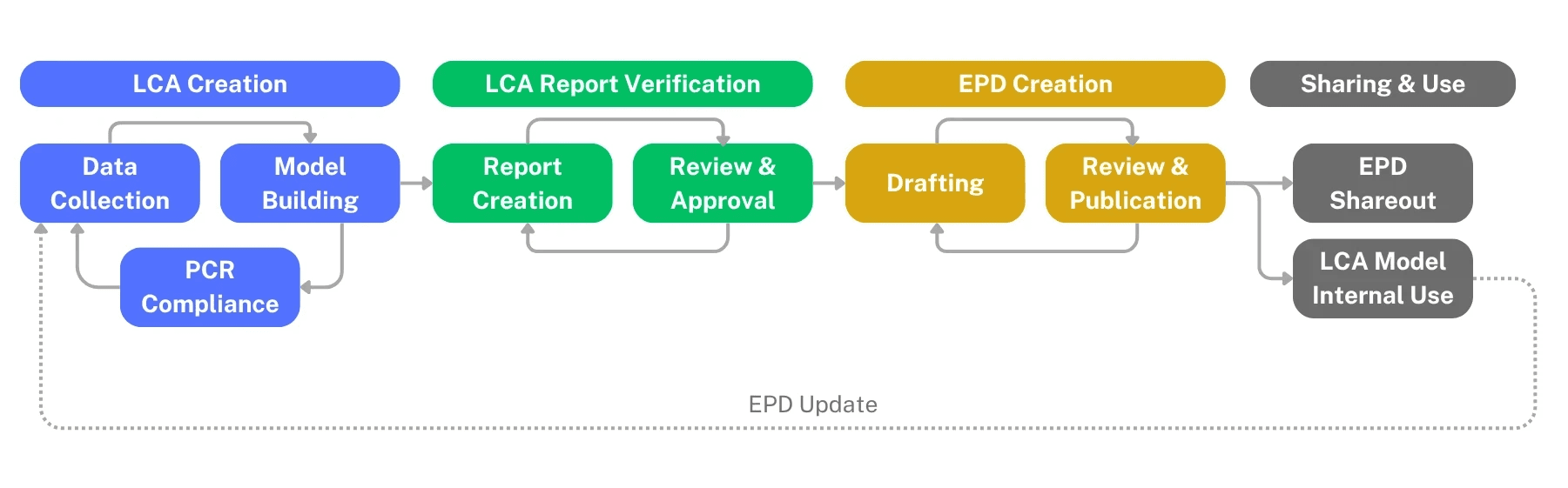
Life Cycle Assessment (LCA) Creation:
PCR Identification: Identify the Product Category Rule (PCR) that defines how impacts must be calculated and reported.
Data Collection: Gather materials, manufacturing, transport, and other lifecycle data from internal and supplier sources.
LCA Modeling: Translate data into a structured life cycle assessment (LCA) model to calculate environmental impacts.
LCA Report Verification:
Report Creation: Document the model, data sources, assumptions, and results in a technical LCA report. This report is not shared publicly.
Independent Review: An external verifier signs an NDA with your organization, and reviews the report and model for compliance with the PCR standards.
EPD Creation:
EPD Creation: Summarize verified environmental impact results into a standardized, public-facing Environmental Product Declaration.
Independent Review: The verifier confirms the EPD aligns with the approved LCA report before publication.
Sharing & Use:
EPD Use: Publish and use the EPD to support buyer procurement decisions and product comparisons.
Internal Product Improvement: Leverage the LCA model to analyze impacts and guide product improvements.
Updating the EPD: Update the model and EPD over time as products, data, or requirements change. EPDs typically expire after 5 years.
Together, these steps form a structured pathway from raw product data to a verified, public-facing EPD. With a clear understanding of how an environmental product declaration is created, the next question is what this work enables and why organizations are increasingly investing in it.
Benefits of an EPD
EPDs are not just compliance documents: they are strategic tools that can support sales, product development, and corporate sustainability goals. Getting an EPD can provide your organization with several key benefits:
Verified Environmental Credibility: EPDs require independent verification, which makes them far more credible than internal claims or marketing-driven sustainability messaging. This credibility is especially important as scrutiny around environmental claims increases.
Access to Sustainability-Driven Markets: Many procurement programs, certifications, and large organizations now require or reward EPDs. In sectors like construction, infrastructure, and manufacturing, not having an EPD can mean being excluded from consideration entirely. For example, government infrastructure and green building projects often require standardized environmental disclosures as part of the specification process.
Standard Basis for Comparison: EPDs follow Product Category Rules (PCRs), which ensure that environmental impacts are calculated consistently across similar products. This allows buyers to make true apples-to-apples comparisons, which is difficult with non-standardized claims that rely on different sets of calculation assumptions.
Foundation for Continuous Improvement: The lifecycle assessment behind an EPD reveals where environmental impacts occur across the product lifecycle. This insight helps your company identify opportunities to reduce emissions, improve materials, and optimize manufacturing processes.
Stronger Product Positioning: For companies with a sustainability advantage such as lower-carbon materials, higher recycled content, or more efficient manufacturing, an EPD provides credible proof. This allows marketing teams to move from claims to verified differentiation, which can reinforce your company's credibility, strengthen proposals, and increase confidence among potential buyers.
Together, these benefits make EPDs more than a just a reporting tool. they are a way to unlock market access, prove product performance, and drive continuous improvement. For many organizations, an EPD becomes both a sales and marketing asset as well as a foundation for long-term sustainability strategy.
Why Environmental Product Declarations are Becoming Essential
Environmental transparency is quickly becoming a baseline expectation across many industries. Organizations are no longer just asking if products are sustainable, they are looking for quantified, verifiable data to support those claims. Two major trends are driving the adoption of EPDs:
Procurement expectations are increasing: Buyers are increasingly requesting environmental impact data as part of supplier evaluation. In many cases, EPDs are becoming a standard requirement for bids, specifications, and long-term contracts.
Regulations and standards are evolving: Governments and sustainability frameworks are introducing requirements aimed at reducing embodied carbon and improving transparency across supply chains. EPDs provide a standardized way to meet these expectations.
Taken together, these forces are turning EPDs from a "nice to have" into a core mechanism for market access and product differentiation. Once you understand the value of an EPD, the next step is understanding what data and inputs are required to produce one.
Is an EPD Right for Your Business?
Organizations approach environmental transparency at different stages. As expectations from customers, regulators, and procurement teams continue to rise, many companies are moving toward more standardized and credible forms of environmental reporting.
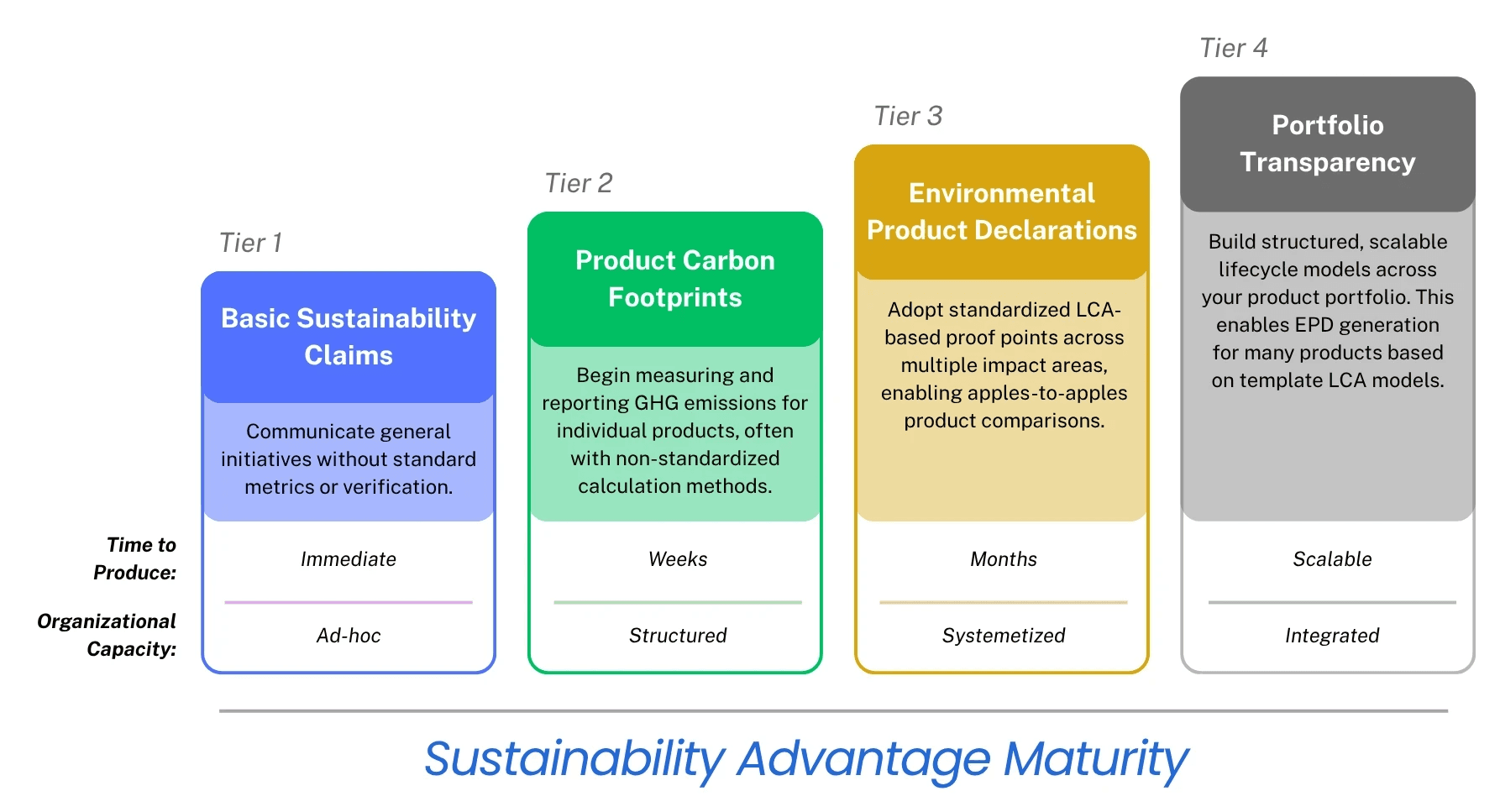
Portfolio transparency is where leading manufacturers operate, and where CarbonGraph is designed to take you.
Environmental Product Declarations sit at a critical point in this progression by providing verified, comparable data that can support procurement decisions, regulatory requirements, and competitive differentiation. The following questions can help you determine whether pursuing an EPD is the right next step for your organization today.
Here are five questions to help you decide whether an EPD makes sense for your organization:
Are EPDs common in my industry? If competitors or partners are publishing EPDs, you may need one to remain competitive.
Are procurement teams asking for environmental impact data? Requests from customers for environmental data indicates a growing demand for standardized disclosures.
Is my industry facing environmental regulations or procurement requirements? Many governments and large organizations now require environmental transparency.
Would verified environmental data help my organization win more deals? EPDs provide trusted, comparable data that strengthens proposals and product specifications, giving you a competitive advantage.
Do I have a sustainability advantage to prove? Low-carbon materials, recycled content, or more efficient manufacturing methods can be validated with an EPD.
What about other Ecolabels? An EPD may not always be the right starting point. Other ecolabels exist, often focused on specific environmental attributes or industries. But few match the rigor, transparency, and third-party verification required for an Environmental Product Declaration.
If your answers to the questions above suggest that an EPD could create value or will soon become necessary, the next step is understanding how the process works in practice. In Part 2 of this series, we’ll break down the LCA-to-EPD process, including what data you need, how lifecycle models are built, and what it takes to get through verification.
A Smarter Way to Approach EPDs
While EPDs are powerful, the process can be complex, especially when managing data, building life cycle assessment models, and preparing for verification.
This is where CarbonGraph comes in. CarbonGraph helps organizations move from product data to verified environmental disclosures by streamlining the entire LCA-to-EPD workflow. Instead of managing disconnected tools and spreadsheets, teams can:
structure product and manufacturing data
build defensible, reusable lifecycle models
generate verification-ready documentation
scale EPDs across their product portfolios
The result is not just a faster path to your first EPD, but a scalable foundation for environmental transparency and product insight. If you’re exploring EPDs for your products, the next step is understanding how the process works, and how to do it efficiently.
Continue to Part 2: Understanding the LCA-to-EPD Process