Understanding the EPD Process
Author:
Alex Crease
What Does it Take to Get an EPD?
In Part 1 of this series, we explored what an Environmental Product Declaration (EPD) is and why it’s quickly becoming essential. But what does it actually take to create one?
While the concept of an EPD is straightforward, the process behind it is highly structured, requiring coordination across data collection, lifecycle modeling, documentation, and third-party verification. This post breaks down the full LCA-to-EPD workflow, so you can understand how product data is transformed into a verified, public-facing environmental declaration.
The LCA-to-EPD Workflow
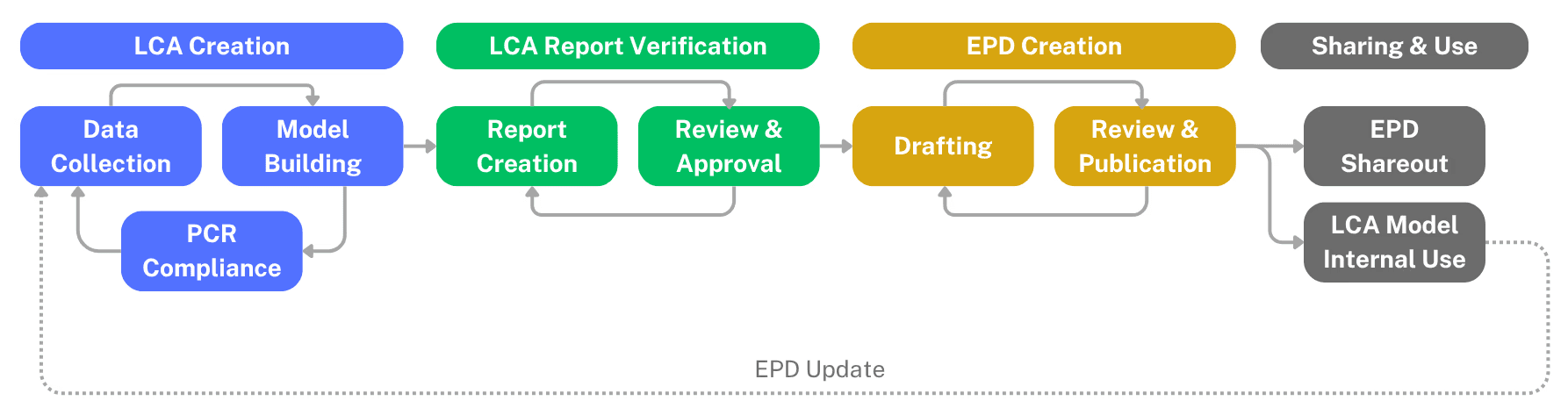
At a high level, creating an EPD follows four core steps, shown in the workflow above:
LCA Model Creation:
PCR Identification: The PCR is a standard created by a regulating body that defines the impact calculation methodology.
Data Collection: Materials, manufacturing, and supply chain data gets collected from internal teams and suppliers.
LCA Model Building: Product data gets translated into a lifecycle model to compute its environmental impacts
Report Verification:
Report Creation: Calculation methodology, assumptions, and results are documented in a detailed technical LCA report.
Report Review: An independent verifier reviews the model and report for compliance via a program operator.
EPD Publication:
EPD Drafting: A standardized, public-facing declaration is drafted based on the verified report.
EPD Review & Publication: A reviewer (often the same one), confirms the EPD and publishes it via the program operator.
Sharing & Use:
EPD Shareout: The EPD can now be shared publicly with procurement teams, buyers, and more.
Model Use: The lifecycle model can be updated and reused for additional products or future EPD updates.
Key Terms:
LCA (Life Cycle Assessment): the method used to quantify environmental impacts across a product lifecycle.
LCA Report: A detailed technical document that describes the lifecycle model, data sources, assumptions, and results. This report is internal and submitted for verification, but is not published as part of the EPD.
PCR (Product Category Rule): the document that defines how impacts must be calculated and reported for a product category.
Program Operator: The organization that manages the EPD verification program, creates the PCR, and publishes the EPDs.
Third-Party Verifier: An independent expert who reviews the LCA model and documentation before publication.
Functional or Declared Unit: The unit of product used to report impacts (e.g., per m² of product).
Primary Data: data collected directly from your operations or suppliers, such as manufacturing energy use or material quantities.
Secondary Data: Data from lifecycle databases or industry reports used to represent processes where primary data is not available.
The LCA Report vs the EPD: You’ll notice two review cycles, one for the LCA report and one for the EPD. The LCA report is a detailed, technical document used for verification and kept internal to your team and the verifier. The EPD is the public-facing output: a standardized, third-party verified summary of the results. In short, the LCA report is the internal documentation that supports and justifies what is published in the EPD.
Where Time is Spent in an EPD Project
The traditional EPD process is resource-intensive and requires coordination across internal and external teams. Many organizations assume the challenge of an EPD is the calculation. In practice, most of the effort is elsewhere.
Timeline: The first EPD typically takes 8–16 weeks to complete.
Workload Split: 60–80% of time between when an EPD project starts and when it is published is spent purely on data collection and stakeholder coordination, not calculation. About 10-30% of the time is spent navigating the review process, leaving only a small portion of time spent actively building the LCA model and writing the report.
Biggest Risk: The biggest risk to publishing your EPD on time is navigating the review process. Verification often leads to rework when there are data gaps, poorly documented assumptions, misalignment with PCR requirements, or report inconsistencies. All of these must be resolved before approval.
Overall, EPDs primarily are a data collection and communication challenge. With a clear starting point and structured approach, teams can move faster and navigate the process with far less friction.
What Do You Need for an EPD?
Creating an EPD starts with understanding the rules and gathering the right data. Because EPDs follow standardized lifecycle methodologies, organizations must align to a defined approach and collect structured data across the product lifecycle. This begins with identifying the appropriate PCR, which determines how the analysis is performed and what data is required.
Identifying the PCR
Creating an EPD starts with one critical foundation: the Product Category Rule (PCR). The PCR describes what must be included, how impacts are calculated, and what data is required so that products in the same category can be easily compared. A PCR typically defines:
functional / declared unit
required lifecycle stages or EPD modules (A1–A3, B1-B7, etc.)
environmental indicators to report
primary vs. secondary data requirements
allocation rules for shared processes
end-of-life modeling assumptions
Because PCRs define the methodology, they determine what data you must collect and how the LCA model is built.
Example: Apparel PCRs require that companies calculate the impact of a garment per day of use. This means a lightweight pair of shoes that lasts only 6 months can be compared against a durable pair of shoes that lasts 5 years. Additionally, data points like scrap rate, transportation modes and distances, and repair and recycling percentages have default values if the manufacturer does not have this data.
Core Data Inputs
Once the PCR is defined, the next step is collecting structured product data. Here is what you need:
Product Definition: Declared unit, system boundaries, and key technical characteristics.
Bill of Materials: Materials, quantities, recycled content, additives, coatings, and packaging.
Manufacturing Data: Energy use, fuels, process inputs, yields, and waste rates.
Transportation & Logistics (if required): Movement of materials and finished goods across the supply chain.
Use Data (if required): Maintenance, repair, energy use, and service life assumptions.
End-of-Life Assumptions (if required): Recycling rates, recovery pathways, and disposal scenarios.
From LCA Model to Verified EPD
These inputs are used to build a lifecycle model that calculates environmental impacts according to the PCR. Each material and process is linked to a background dataset that translates those inputs into quantified environmental impacts, forming the foundation of the lifecycle model. The methodology, data sources, assumptions, and results are documented in a detailed LCA report, which serves as the technical foundation for the EPD.
This report is an internal document and is not published. Instead, it is submitted for independent third-party verification through a program operator. During this process, a verifier reviews the model and report, provides feedback, and may request revisions to ensure compliance with PCR and standards requirements.
Once approved, the verified results are used to create the Environmental Product Declaration (EPD): a standardized, public-facing summary of the study. The EPD receives final approval before being published by the program operator.
In practice, producing an EPD requires a clear PCR, structured product data, a defensible lifecycle model, and thorough documentation. The more organized your data and assumptions are upfront, the smoother the process will be.
Are You Ready To Get Started?
Consider the following key elements before getting started with your first EPD project:
PCR has been identified
Relevant stakeholders and suppliers notified and aligned
Product and manufacturing data is readily available
Lifecycle modeling capability is established
Verification program operator is selected
Organizations that address these early can significantly reduce delays and rework.
A Better Way to Approach the Process
By now, it’s clear that producing an EPD is not just a technical exercise, but also a data, workflow, and coordination challenge. Most of the effort is not in the calculations themselves, but in structuring data, aligning with PCR requirements, and preparing a model that can successfully pass verification.
CarbonGraph is built specifically for the LCA-to-EPD process, helping teams move from fragmented product data to verification-ready lifecycle models in a single, structured workflow. Instead of managing spreadsheets, disconnected tools, and iterative documentation cycles, organizations can:
structure product and manufacturing data in one place
build defensible lifecycle models aligned with PCRs
generate documentation as the model is created
collaborate more effectively with verifiers and program operators
reuse models to scale EPDs across product lines
The result is a faster, more reliable path to your first EPD, and a foundation that can support ongoing environmental transparency at scale.
In Part 3, we’ll explore common pitfalls in more detail and outline best practices for successfully navigating the EPD process.
Continue to Part 3: Common Pitfalls and Best Practices