Monte Carlo Analysis in CarbonGraph: Defensible Uncertainty for EPDs and LCAs
Author:
Luke Boivin
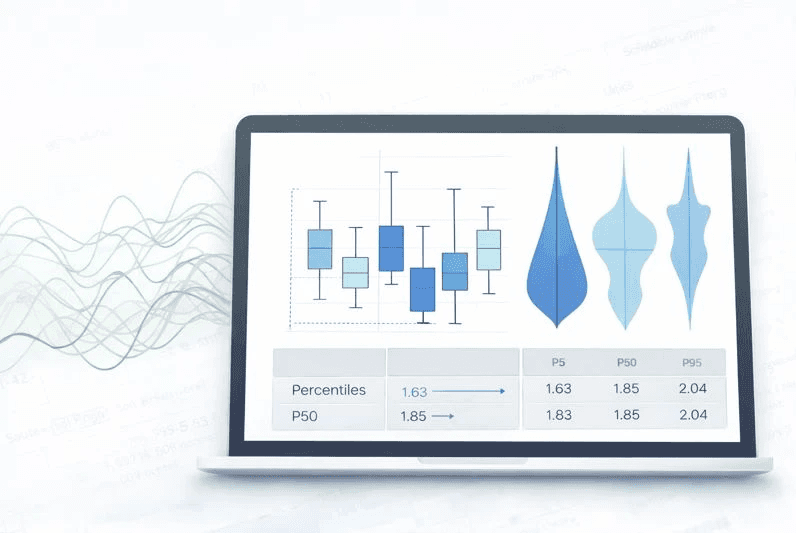
LCAs aren’t deterministic. Your results shouldn’t be either.
In real projects, very few inputs are truly fixed.
Transport distances vary.
Supplier data changes.
Yields fluctuate.
Emission factors come with measurement error.
Yet many LCAs — and even published EPDs — still report single-point results.
For consultants and verifiers, that creates friction:
“How sensitive is this assumption?”
“What’s the expected range?”
“How confident are we in this number?”
“Can you document the uncertainty treatment?”
Increasingly, you’re not just asked these questions — you’re required to report them.
Many PCRs, ISO-aligned studies, and verification processes expect:
uncertainty characterization
sensitivity analysis
statistical ranges or percentiles
documented assumptions
Historically, this meant spreadsheets, manual scenario runs, or external tools.
Now it’s built directly into CarbonGraph.
Introducing Monte Carlo Analysis
CarbonGraph now includes native Monte Carlo simulation across any model or flowsheet.
You can:
Assign probability distributions to uncertain parameters
Run thousands of randomized scenarios
Recalculate full impacts for each iteration
Report statistical ranges alongside your results
All using the same impact methods you already use (TRACI, EF, CML, etc.).
No exports. No side tools. No duplicated models.
How it works
Define uncertainty where it matters
Assign distributions to parameters such as:
transport distances
scrap rates
yields
emission factors
prices or consumption rates
Supported distributions:
Fixed
Normal
Lognormal (μ/σ or Median/GSD)
Uniform
Triangular
Beta
Gamma
This lets you match the math to the real-world behavior of each variable.
Run thousands of scenarios
CarbonGraph:
samples new parameter values
recomputes the full model
re-runs all impact methods
repeats for each iteration
You’re evaluating your actual LCA, not an approximation.
Seed control ensures results are reproducible for audits and verification.
Report defensible outputs
Instead of:
GWP = 1.82 kg CO₂e
You can report:
GWP = 1.82 kg CO₂e
P5–P95: 1.63–2.04 kg CO₂e
Outputs include:
Percentiles
Box plots
Violin plots
Histograms
Tabular summaries
These can be directly used in:
EPD documentation
verification packages
sensitivity appendices
internal QA
What this enables for EPD consultants
✔ Meet reporting & verification expectations
Document uncertainty explicitly instead of relying on assumptions.
Provide:
ranges
distributions
reproducible methods
This reduces back-and-forth during verification.
✔ Identify which inputs actually matter
Quickly see which parameters drive variance.
Focus your data collection where it improves accuracy the most.
✔ Avoid over-interpreting small differences
If two products differ by 2% but uncertainty is ±10%, that’s not a meaningful comparison.
Monte Carlo makes that obvious.
✔ Build more credible studies
Presenting ranges and percentiles signals scientific rigor and transparency — especially for:
ISO 14040/44 studies
EPDs
research-grade assessments
Why we built this
Consultants shouldn’t have to leave their LCA platform to do statistically sound analysis.
Monte Carlo turns CarbonGraph from a single-number calculator into a decision and verification tool.
It helps you:
defend assumptions
quantify risk
and submit stronger, more transparent EPDs
Available now
Open any flowsheet → Uncertainty Analysis → define distributions → Run Analysis
If you want help choosing distributions or interpreting outputs, we’re happy to help.