How Nucor Is Building EPDs at Enterprise Scale
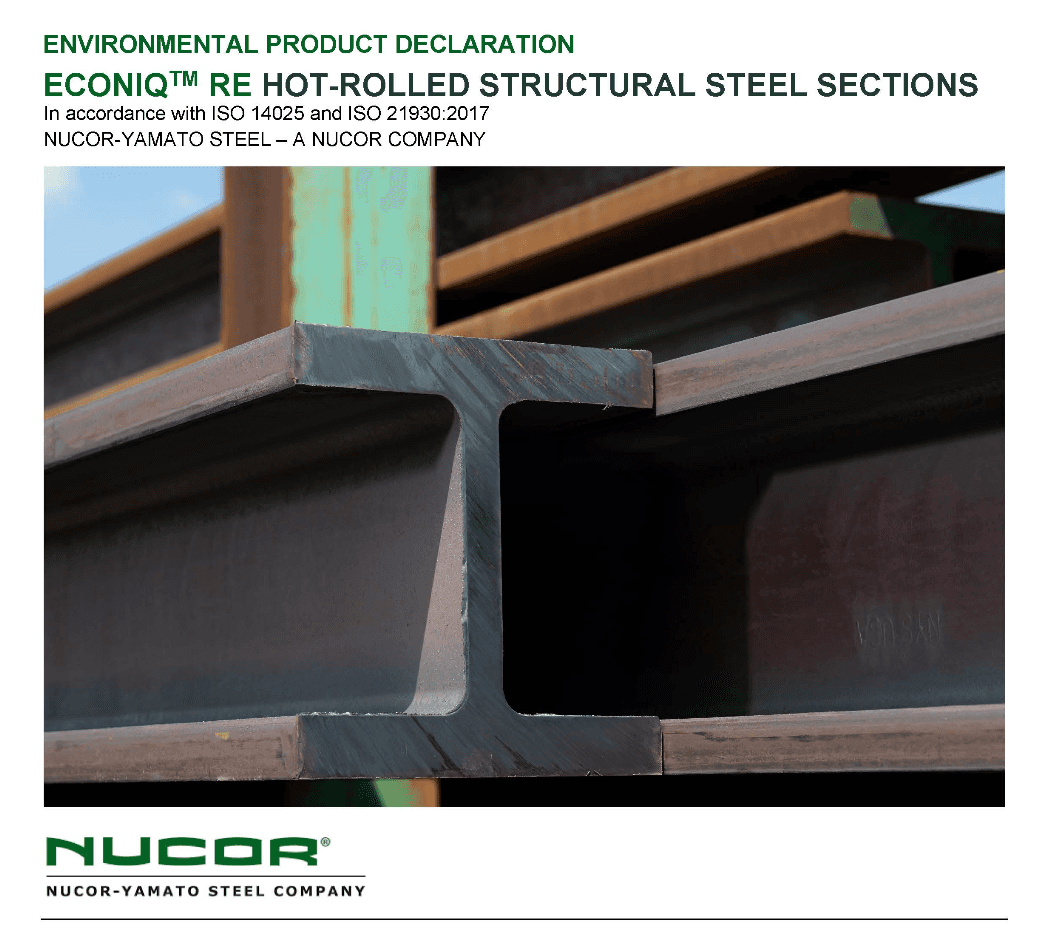
Nucor-Yamato Steel, a division of North America's most diversified steel and steel products company, Nucor, sought to create an Environmental Product Declaration (EPD) for their hot-rolled structural steel sections. This EPD was for their low-emission products, which recently achieved record certification from the Global Steel Climate Council (GSCC). The EPD was developed to quantify the environmental performance of their Electric Arc Furnace (EAF) steel products, which are produced primarily from over 80% recycled scrap steel. The underlying Life Cycle Assessment (LCA) model was built in CarbonGraph, and Nucor was able to streamline their certification process by using SmartEPD to verify and publish their results.
Sustainability Advantages Proven in the EPD
The EPD validates several key sustainability advantages inherent in Nucor-Yamato Steel’s production process, which contributed to its record low-emission certification:
High Recycled Content: The hot-rolled structural steel sections are manufactured using at least 82% scrap steel as raw materials. The 2024 nationwide average for Nucor Beam products was 81.6% recycled content.
Low Emissions Technology: The facility utilizes EAF technology, which is described as less energy intensive and more energy efficient than traditional blast furnace steelmaking. As a result, Nucor, which accounts for over 25% of U.S. steel production, only accounts for 8% of the domestic steel industry's greenhouse gas (GHG) emissions.
Waste Recycling: Nucor recycles 99% of the EAF dust collected in its baghouses.
The Baseline CarbonGraph LCA Model
The LCA model established a transparent and detailed baseline for the product’s environmental impact. The core purpose of the model was to generate the EPD results.
Scope and Unit: The study utilized a Cradle-to-Gate scope (A1-A3), with a Declared Unit of 1 metric ton of product.
Data Specificity: The EPD is defined as facility-specific and product-specific, using primary production data collected directly from the site for the Calendar Year 2024.
Methodology: The EPD results were calculated using established methodologies, including IPCC AR6 GWP 100 and TRACI 2.2.
Data Sources: The model integrated a mix of primary and generic data, with the foreground LCI database including US LCI v. FY21.Q3.01 and Ecoinvent v. 3.9 and 3.11.
How CarbonGraph Enables Nucor to Quantify and Justify
Using the CarbonGraph LCA model, Nucor is able to quantify and prove its environmental performance with a level of detail necessary for modern sustainable construction and procurement:
Quantifiable Environmental Impacts: The model precisely quantifies key environmental impacts for 1 metric ton of hot-rolled structural steel sections. For example, the total Global Warming Potential (GWP-total) across the production stage (A1-A3).
Identification of Impact Hotspots: The model provides a breakdown of impacts by life cycle module (A1, A2, A3), enabling Nucor to identify where to focus reduction efforts. The results showed that Module A3 (manufacturing) is the largest contributor to key impact categories like Global Warming Potential-Total, Global Warming Potential-Fossil, and Global Warming Potential-Biogenic.
Justification of Material Choice: The EPD, which adheres to international standards like ISO 21930:2017, justifies Nucor's commitment to EAF technology and recycled content by providing a transparent, Smart EPD third-party-verified quantification of the resulting environmental footprint.
Detailed Material/Process Flows: The model supports the in-depth documentation of all material inputs and unit processes, including raw materials (e.g., scrap metal, ferroalloys, lime), energy sources (e.g., grid electricity, natural gas), and transportation methods (e.g., truck, train, ship, barge).
CarbonGraph is a Smart EPD pre-verified software platform.